The 17 symmetry groups of the plane can be grouped into five
sections, according to the maximum order
of rotations :
• Symmetry groups without rotations : p1, cm , pm , pg
.
• Symmetry groups with 180º rotations : p2, cm , pmm , pgg
, pmg .
• Symmetry groups with 120º rotations : p3m1, p31m,
p3.
• Symmetry groups with 90º rotations : p4, p4m,
p4g.
• Symmetry groups with 60º rotations : p6, p6m.
Crystallographic notation for symmetry groups and how
to interpret the symbols:
The letter p or c indicates the primitive or
centered cell
. The number following p indicates the highest
order of rotation; for example , if it is
6, it has a 1/6 rotation.
m represents a mirror reflection perpendicular to the
X- axis . G ( glide ) indicates a glide reflection , but not a reflection perpendicular to
the X- axis . The X- axis refers to the left vertical edge of the
cell . A 1 indicates that there is
no axis of symmetry perpendicular to the X- axis
. The last symbol represents an axis of
symmetry at an angle to the
X- axis .
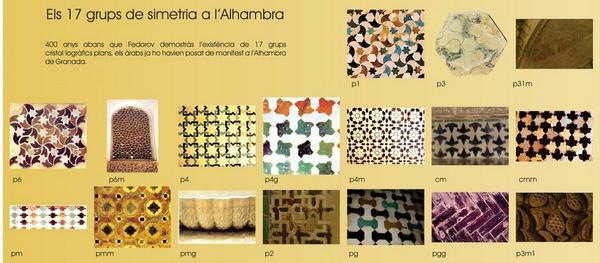
How to recognize the family of
a mosaic pavement?
🌿 Classification of the 17 plane symmetry groups
No rotation (nothing)
Is there any reflection ?
• Yeah
:
Is there a
sliding line that is not
a line of symmetry?
or Yes → cm
No → pm
Is there
a sliding reflection ?
or Yes → page .
No → pl
• No: → nothing
order turnover 2
Is there any reflection ?
• Yeah
:
Are there two- way reflections ?
or Yes →
Are all the centers of rotation
on the line
of symmetry?
Yes
→ pmm
No → cmm
or No
→
Is there
a sliding reflection ?
or Yes → pgg
or No
→ p2
• No: → p2
order turnover 3
Is there any reflection ?
• Yeah :
Are all the centers of rotation
on the line
of symmetry?
or Yes → p3ml
or No
→ p3lm
• No: →
p3
order turnover 4
Is there any reflection ?
• Yeah :
Are there lines of symmetry that
intersect at a 45° angle?
Yes
→ p4m
or No
→ p4g
• No: →
p4
order turnover 6
Is there any reflection ?
• Yes :
→ p6m
• No: → p6
The translation
vectors form a non-rectangular parallelogram.
1. p1 has no rotations
, no reflections, no glides
; they are two linearly independent translations .
2. p2 half
turn at the
corners, the centers of the
edges and the centers of
the faces, two independent translations . The translation vectors form a rectangle.
3. pm
has no rotations , no glides
, two reflections through parallel sides. Translations parallel and orthogonal
to these sides.
4. pg has no rotations
, no reflections, it slides through two parallel sides,
two orthogonal translations .
5. cm
has no rotations , reflections
through the diagonal, two parallel glides
.
6. pmg
half turn at the corners,
the centers of the edges
and the centers
of the faces; two parallel reflection
lines ; center line of sliding
.
7. Half turn pgg at corners, edge centers and
face centers; no reflections;
two orthogonal glide lines .
8. pmm
half turn at corners, centers
of edges and centers of
faces; reflections on sides and center
lines ; no slippage .
9. Half- turn of cmm at the corners, edge
centers , and face centers; two orthogonal
reflections ; four parallel glides . The translation vectors form
a square .
10. The rotations of p4 are 4 turns at the corners
and centers of the face, and
half a turn at the centers
of the sides;
there are no reflections or glides .
11. p4m Quadruple rotations
at corners and face centers, half turns at
side centers ; eight reflections; four glides . The
quadruple rotation centers lie on
lines of reflection .
12. p4g Quadruple rotations
about corners and face centers, half turns about
side centers; four reflections; six glides . The
quadruple rotation centers do not lie on lines
of reflection. Translation vectors of equal
length at 60 degrees.
13. Three p3 rotations at the vertices
and centers of the triangle;
without reflections or glides .
14. Three p3m1 rotations
at the vertices
and centers of the triangle;
five reflections; nine glides . The
centers of rotation appear three times on the lines of
reflection.
15. From page 31m, triple rotations are observed at the
vertices and centers of the
triangle; five reflections; four glides . The centers
of the quadruple
rotation are not on lines of
reflection.
16. Rotations at the corners, of
p6 rotations of 6 folds , rotations of 4 folds at
the centers of the sides
and faces; rotations of 3 folds at
the centers of the triangles;
without reflections or glides .
17. 6 times rotations of
p6m at the corners, 4 times rotations at the centers
of the sides
and 3 times rotations of the centers
of the faces at the centers
of the triangles;
ten reflections and ten glides .


