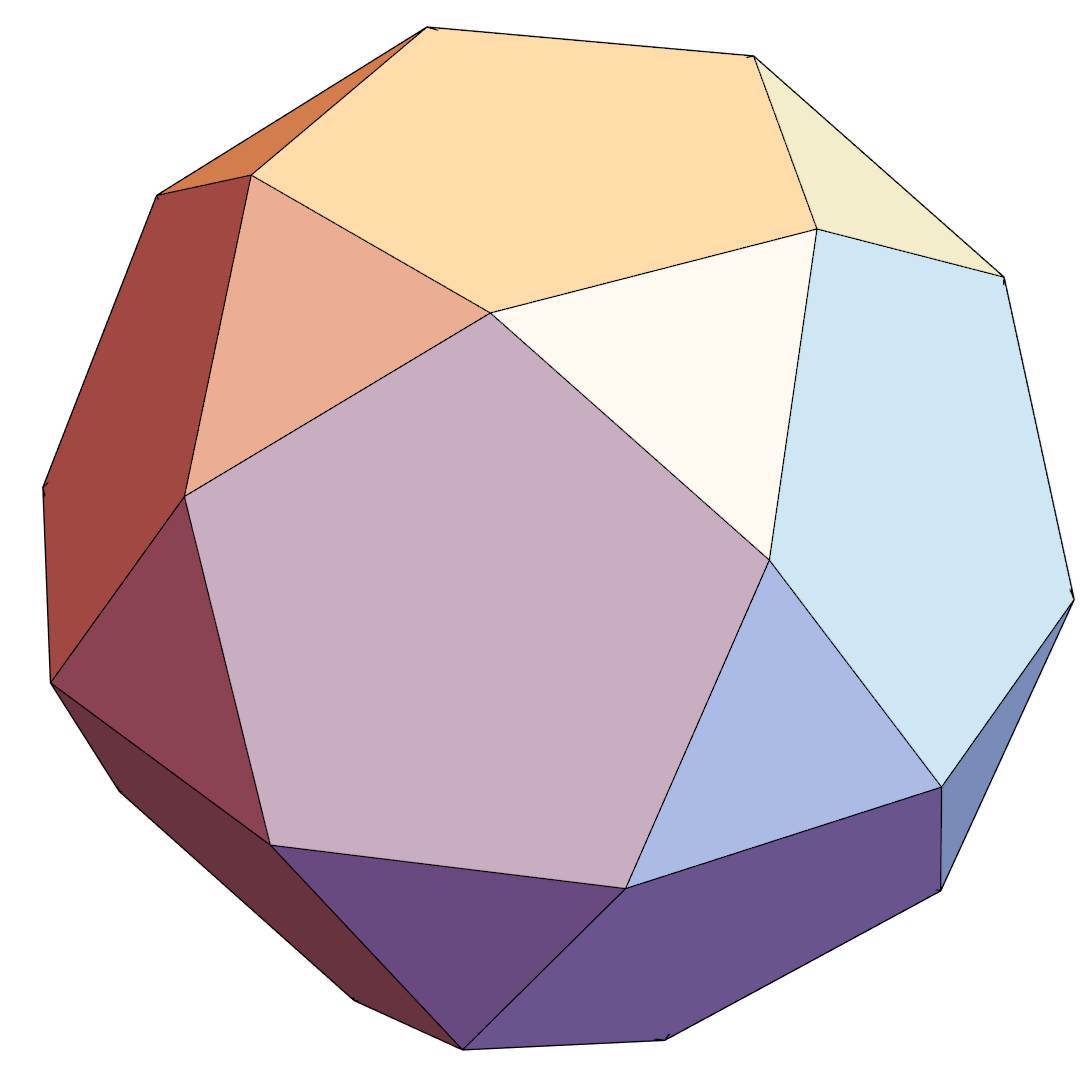
Ambo Polyhedron
Kepler and the rectified polyhedra = ambo of
Conway polyhedra
-
1. The geometric operation of "rectification" of a polyhedron
In modern geometry (especially
since the work of Coxeter and Conway
's notation ), "rectifying" a polyhedron (P) is an operation
that produces a new polyhedron ( operatorname { rect }(P) ), whose vertices are the midpoints of the edges
of (P).
How is it built?
1. “Take the midpoints of each edge” of the original polyhedron.
2. “These points become the vertices” of the new polyhedron.
3. “The original faces” are reduced to new faces, with the same number of
sides but smaller (they are “truncated to half the edges”).
4. The “original vertices” disappear; instead, for each vertex of the
original polyhedron, a new face appears. This new face has as many sides as
edges converged at the original vertex (i.e., a face of type (n) -gonal where (n) is the degree of the vertex).
Therefore, rectification transforms:
- Faces with (n) sides → Faces with (n) sides (smaller).
- Vertices of degree (m) → Faces of (m) sides.
This preserves the original symmetry.
Key properties
Rectifying a polyhedron and
its dual yields the same result. For example, rectifying the cube and
octahedron (which are duals of each other) produces the cuboctahedron
. Rectifying the dodecahedron and icosahedron produces the icosidodecahedron .
- It is equivalent to a
“complete truncation” (to the midpoint of the edges).
- In Conway terms
, the operation is called “ambo” (a)
Examples
| Original polyhedron |
Rectified polyhedron | Rectified faces |
| Tetrahedron | Octahedron
(regular) | 8 triangles ( 3 for each vertex of the
tetrahedron + 4 triangles from the original faces? ) *Note: the rectified
tetrahedron is the octahedron; its faces are the 4
triangles from the original faces and the 4 triangles from the vertices, totaling 8. |
| Cube | Cuboctahedron | 8
triangles (from the 8 vertices of the cube) + 6 squares (original faces
reduced) |
| Octahedron | Cuboctahedron |
6 squares (from the 6 vertices of the octahedron) + 8 triangles (original faces
reduced) → The same cuboctahedron |
| Dodecahedron | Icosidodecahedron | 20 triangles (from the 20 vertices) +
12 pentagons (original faces) |
| Icosahedron | Icosidodecahedron | 12 pentagons (from the 12 vertices) +
20 triangles (original faces) → Same solid |
2. Kepler and the rectified polyhedra
Although the word
"rectification" in the modern sense does not appear in his texts, the
geometric process I have described is exactly what Johannes Kepler explored in
his book " Harmonices Mundi " (1619, *The
Harmonies of the World*), Books I and II.
Rediscovery of Archimedean solids
The 13 Archimedean solids
(convex polyhedra with regular faces of two or more
types, identical vertices) had been described by Archimedes, but his work was
lost and references were only known in Pappus . “Kepler reconstructed them all” and presented them
systematically for the first time in the modern era, with names that in many
cases have endured.
For him they were “perfect
figures of the second order” (the Platonic ones were of the first order).
Kepler showed how to obtain them from the Platonic ones through truncations,
cuts at the vertices and edges.
Among those 13, two are precisely the ones we now call
"rectified":
- The “
cuboctahedron ”: Kepler called it *a truncated cube and a truncated
octahedron at the same time*, because he observed that truncating the cube at
the midpoints of its edges and truncating the octahedron in the same way yields
the same solid. He considered it a fusion of both truncations.
- The “ icosidodecahedron ”: Same relationship between
dodecahedron and icosahedron. Kepler explicitly describes it as a body that can
be generated “by truncating the dodecahedron or the icosahedron until the edges
become points”, that is, until the midpoints.
Keplerian construction step by step
(example cube → cuboctahedron )
Kepler in * Harmonices Mundi *, Book II, proposition XXVIII, describes
the truncation of the cube:
1. On each
edge of the cube mark two points that divide
it according to the extreme and average (golden) proportion or, in the limiting
case, exactly in the middle.
2. Cut planes that pass
through those points, eliminating the corners of the cube.
3. If you cut the edge in
half, the original square faces become smaller squares, and an equilateral
triangle appears at each former vertex. The result is a solid with 6 squares
and 8 triangles: the cuboctahedron .
Kepler did not limit himself
to construction; he also “calculated metric properties” (edges, radii of
inscribed and circumscribed spheres) as a function of the original radius, and
explored how these solids could be inscribed in one another.
Keplerian nomenclature and notation
Kepler used descriptive Latin
names:
- “
Cuboctahedron ” (from * cubus * + * octahedron
*) → * cuboctahedron *.
- “ Icosidodecahedron ” (* icosadodecahedron
* + * dodecahedron *) → * icosidodecahedron *.
These names were
adopted by later tradition and are the ones we use today.
Star polyhedra and the rectification operation
Kepler also discovered the two
"regular stellated polyhedra" (the * stella octangula
* and what are now called the Kepler- Poinsot solids:
the small stellated dodecahedron and the large stellated dodecahedron).
Although they are not directly rectified, their formation involved faceting and
face extension processes , which in modern theory are related to the operations
of rectification and truncation in symmetry spaces.
When in modern geometry we
talk about "rectifying a polyhedron", the result is precisely the
Archimedean solids that Kepler rediscovered and described with the method of
complete truncation to the midpoint
In expanded summary
- “Rectification (modern)”: an
operation that creates a polyhedron whose vertices are the midpoints of the
edges of the original. It transforms original faces into reduced versions and
vertices into new faces. It is a particular case of total truncation.
Kepler reconstructed the 13
Archimedean solids , including the cuboctahedron and
the icosidodecahedron , which are exactly the
rectified versions of the cube/octahedron and the dodecahedron/icosahedron. He
obtained them through symmetrical truncations that coincide with modern
rectification.
- His treatise * Harmonices Mundi * provides the first classification,
nomenclature and metric study of these polyhedra,
laying the foundations for the later development of the geometry of operators
on polyhedra.
The table with the “13
Archimedean solids ” in Conway notation and Kepler's
description of each one. I will take as a starting point the Platonic solids: T
(tetrahedron), C (cube), O (octahedron), D (dodecahedron), I (icosahedron).
The 13 Archimedean solids according to Kepler and in Conway notation
Archimedean solid (modern name) | Name given by Kepler | Conway notation |
How Kepler constructed/described it |
| 1 | “Truncated tetrahedron” | * Tetraëdron truncum * | “ tT
” | Truncate each vertex of the tetrahedron until the triangular faces become
regular hexagons and the vertices become equilateral triangles. |
| 2 | “Truncated Cube” | * Cubus truncus * | “ tC ” | Cut the corners of the
cube until the original squares are transformed into regular octagons and
triangles appear at the truncated vertices. |
| 3 | “Truncated octahedron” | * Octaëdron truncum * | “ tO
” | Truncate the vertices of the octahedron; the triangular faces become
hexagons and the truncated vertices become squares. Kepler noted that it is the only Archimedean tessellation that tiles space.
|
| 4 | “Truncated dodecahedron” | * Dodecaëdron truncum * | “ tD
” | Truncate the corners of the dodecahedron; the pentagons
become decagons and the vertices become triangles. |
| 5 | “Truncated icosahedron” | * Icosaëdron truncum * | “ tI
” | Truncating the icosahedron; the triangular faces become regular hexagons
and the cut vertices become pentagons. Kepler recognized it, although it is more
famous for its association with the fullerene . |
| 6 | “ Cuboctahedron ” | * Cuboctahedron * | “ aC ” (= aO ) | Truncate the cube
*exactly at the midpoint of its edges* (or do the same with the octahedron).
The square faces are reduced and the vertices become
triangles. Kepler observed that this is the point of intersection between the
cube and the octahedron.
| 7 | “ Icosidodecahedron
” | * Icosidodecahedron * | “ aD
” (= aI ) | Truncate the dodecahedron or icosahedron
to half its edges. The original pentagons become smaller and the vertices
produce triangles. |
| 8 | “ Rhombicuboctahedron
” (small) | * Rhombicuboctahedron * | “ eC ” (= eO ) | “Expand” the cube:
separate each face, add a rectangle for each edge and a square for each
original vertex. Kepler described it as a smooth truncation, where the faces are not completely removed but belts of squares are added. |
| 9 | “ Rhombicosidodecahedron
” (small) | * Rhombicosidodecahedron * | “ eD ” (= eI ) | Expansion of the
dodecahedron: each pentagon moves further away, each edge becomes a square, and
each vertex becomes a triangle. Kepler considered it an “even more perfect”
figure because of its rich symmetry. |
| 10 | “Great rhombicuboctahedron ” ( truncated cuboctahedron ) | * Truncum
Cuboctaëdron * | “ bC ” (= bO ) | Truncate the cuboctahedron (or apply a bevel to the
cube). Octagons, hexagons, and squares result. Kepler says it is a deeper
truncation of the cube, beyond the cuboctahedron . |
| 11 | “Great rhombicosidodecahedron ” ( truncated icosidodecahedron )
| * Truncum Icosidodecahedron
* | “ bD ” (= bI ) |
Similarly, truncating the icosidodecahedron yields
decagons, hexagons, and squares. Kepler obtained it by “extreme corner
cutting”. |
| 12 | “Snub cube” | * Cubus simus
* | “ sC ” | It is obtained
by “twisting” the faces of the cube and filling the gaps with triangles. Kepler
described it as a solid where the original faces are rotated
and each former edge becomes two triangles. It is chiral ;
it exists in two mirror-image forms.
| 13 | “Snub dodecahedron” | * Dodecahedron simum
* | “ sD ” | Same as the
snub cube but derived from the dodecahedron. Kepler considered it legitimate as
a second-order figure, although its construction is more complex. |
Important observations
- “ Conway notation ”: the letters indicate
operators applied to an initial Platonic solid:
- “t” = truncate (cut vertices)
- “a” =ambo / rectify (midpoints of the edges)
- “b” = bevel ( to bevel , is equivalent to
t ∘ a )
- “e” = expand (separate faces and add belts of squares or
triangles)
- “s” = snub (twist and fill with triangles)
- The equality between seeds (e.g., aC = aO )
reflects duality: cube and octahedron are dual, and when rectified they give
the same solid; the same applies to dodecahedron and icosahedron.
The names “ rhombi- ”, “ cuboctahedron ”, “ icosidodecahedron ”, and “ simus
” are exactly those coined by Kepler in Harmonices
Mundi (1619) and have survived to this day. His classification is the first
complete one and marked the rebirth of the geometry of semiregular polyhedra .
Kepler did not use the word
"rectification" for polyhedra, but his
description of "truncating to half the edges" is "exactly" Conway 's "ambo(a)" operation , the current
rectification. Therefore, the Archimedean solids that we now call *rectified* ( cuboctahedron and icosidodecahedron
) are the Keplerian "ambos" .
Basic
meaning: In its simplest form, the Ambo process is an operation that takes a
polyhedron and produces a new polyhedron whose vertices are the midpoints of
the edges of the original polyhedron. Imagine each edge of a polyhedron. Now
mark its midpoint. If we connect all these midpoints in a specific way
(explained later), we will obtain a new polyhedron: the Ambo of the original.
Step-by-step process:
To apply the
Ambo process to a polyhedron, the following steps are
followed:
Identify the
new vertices: The new vertices are exactly the midpoints of all the edges of
the original polyhedron.
Connecting
the vertices: To form the faces of the new polyhedron, the new vertices are connected according to this rule: Two new vertices
(midpoints) are connected to form an edge Ambo if the original edges from which
they come shared the same face in the original polyhedron.
Resulting
polyhedron type: The ambo polyhedron is always a uniformly grouped vertex
polyhedron, meaning that all its vertices are identical by grouping.
Relationship
to the original: The ambo has one face for each face of the original
polyhedron. However, if the original face had n sides, the corresponding new
face will also have n sides, but will be smaller and "cut off"
(remaining in the center of the original face).
The ambo has
one face for each vertex of the original polyhedron. Each vertex of the
original, where there were m edges, becomes a new m-sided face in the ambo.
In notation: Ambo(Ambo(P))
is similar to P.
Practical
examples:
Ambo of the
cube. Original polyhedron: Cube (6 square faces, 8
vertices, 12 edges). Process: The midpoints of the 12 edges of the cube are taken.
The
resulting polyhedron is a cuboctahedron . It has 12
vertices (one for each edge of the cube). It has 14 faces: 6
squares (from the 6 faces of the cube) and 8 triangles (from the 8 vertices of
the cube). All its vertices are identical: at each one, a square and two
triangles meet.
2. Ambo of
the Octahedron Original Polyhedron: Octahedron (8 triangular faces, 6 vertices,
12 edges). Process: The midpoints of the 12 edges of the octahedron are taken. Resulting ambo polyhedron: Again, a cuboctahedron .
This shows
that the cube and the octahedron (which are dual polyhedra)
produce the same polyhedron.
3. Ambo of
the Dodecahedron
Original
polyhedron: Dodecahedron (12 pentagonal faces). Resulting polyhedron: An icosidodecahedron . It has 30 vertices (corresponding to the 30 edges of the
dodecahedron). It has 32 faces: 12 pentagonal and 20 triangular.
Relationship
with other operators and applications:
The Ambo
process is fundamental in polyhedron theory and is one of the Conway operators , named after the mathematician John Horton Conway
.

These
operators (such as "rectify," "truncate,"
"expand," etc.) allow the generation of a vast family of polyhedra from the Platonic solids. The Ambo process is, in
fact, identical to the rectification process, where the vertices of the
original polyhedron are "cut" until the cutting plane exactly reaches
the midpoints of all the edges. Its best-known application is the first step in
constructing a soccer ball (a truncated icosahedron) or fullerenes (carbon
molecules), starting with an icosahedron and applying operations that include
the Ambo/rectification process.
.
Summary
In essence, the ambo is a geometric
transformation process that: Reduces the symmetry of the polyhedron to vertices
that are uniform with each other.
It creates a
polyhedron intermediate between a polyhedron and its
dual. It increases the number of faces (by adding the faces and vertices of the
original). It is a fundamental tool for generating and classifying complex polyhedra from simpler ones.
The origin
of the word "ambo" in this geometric context is very specific and is
directly linked to the work of the mathematician John Horton Conway
.
Direct
origin: John Horton Conway. The term "ambo" was
coined by the prolific and brilliant mathematician John Horton Conway
(1937–2020) as part of his system of polyhedral operators. Conway
, known for his playful and creative style of naming mathematical
concepts, developed a notation where simple letters or syllables represent
fundamental operations that can be applied to a polyhedron to generate a new
one.
Etymology and meaning of the
term
The word
"ambo" comes from Latin, where it means "both." Why did
Conway choose this term?
The reason
is deeply descriptive and captures the very essence of the operation: the
polyhedron resulting from the "ambo" operation can
be considered to belong to both polyhedra: the
original and its dual.
Let's take
the classic example: the dual of a cube is a cuboctahedron ,
and the dual of an octahedron (which is the cube's dual) is also a
cuboctahedron . The resulting cuboctahedron is, therefore, a kind of
"hybrid" or "intermediate state" that shares characteristics
of both parent polyhedra (the cube and the
octahedron). It is an almost regular polyhedron that
sits right in the middle of the dual pair. In essence, the "dual"
polyhedron is the "child" that equally inherits the properties of
both parents (the solid and its dual).
In notation: Ambo(Ambo(P)) is similar to P.
Relationship
with other operators and applications: The ambo process is fundamental in
polyhedron theory and is one of the Conway operators ,
named after the mathematician John Horton Conway . These operators (such as
"rectify," "truncate," "expand," etc.) allow the
generation of a vast family of polyhedra from the
Platonic solids. The ambo is, in fact, identical to the rectification process,
where the vertices of the original polyhedron are "cut" until the
cutting plane exactly reaches the midpoints of all the edges.
Most well-known application: It is the first step in the
construction of a soccer ball (truncated icosahedron) or fullerenes (carbon
molecules), starting from an icosahedron and applying operations that include
ambo/rectification.
Summary: In
essence, the ambo is a geometric transformation process that:
It reduces
the symmetry of the polyhedron to vertices that are uniform with respect to
each other. It creates a polyhedron intermediate between a polyhedron and its dual. It increases the number of faces (by adding the
faces and vertices of the original). It is a fundamental tool for generating
and classifying complex polyhedra from simpler ones.
The origin
of the word "ambo" in this geometric context is very specific and is
directly linked to the work of the mathematician John Horton Conway
.
Direct origin : John Horton Conway. The term "ambo" was coined by the prolific and brilliant mathematician John
Horton Conway (1937-2020) as part of his system of polyhedral operators. Conway , known for his playful and creative style of naming
mathematical concepts, developed a notation where simple letters or syllables
represent fundamental operations that can be applied to a polyhedron to
generate a new one.
Etymology and meaning of the
term
The word "ambo" comes from Latin,
where it means "both." Why did Conway choose this word? The reason is
profoundly descriptive and captures the very essence of the operation: the
polyhedron resulting from the ambo operation can be
considered to belong to both polyhedra: the
original and its dual. Let's take the classic example: the ambo of a cube is a cuboctahedron , and the ambo of an octahedron (which is the
dual of the cube) is also a cuboctahedron . The resulting cuboctahedron is,
therefore, a kind of "hybrid" or "intermediate state" that
shares characteristics of both parent polyhedra (the
cube and the octahedron).
It is a quasi-regular polyhedron that lies
precisely in the middle of the dual pair. Essentially, the ambo polyhedron is
the "child" that equally inherits the properties of "both"
parents (the solid and its dual). In Conway notation ,
operators are applied as a string of letters to the description of a seed
polyhedron (e.g., "T" for tetrahedron, "C" for cube,
"O" for octahedron, "D" for dodecahedron, "I" for
icosahedron). The operator "a" (ambo) is one of the most fundamental.
For example: aC means "ambo of cube," which
is the cuboctahedron . aO means "ambo of octahedron," which is
also the cuboctahedron . aD
(ambo of dodecahedron) produces the icosidodecahedron
.
Summary : Creator : John Horton Conway. Original
language: Latin. Literal meaning: "Both." Reason for its name:
Because the resulting polyhedron acts as an intermediate or common point
between a polyhedron and its dual, sharing properties of both. It is a perfect
example of Conway 's genius : a short, memorable, and
deeply descriptive term that encapsulates the essence of a complex geometric
transformation.
Comparative Summary Table
|
|
Regular |
Uniform Polyhedra |
Johnson polyhedra |
|
Faces |
One type of regular face |
Regular faces (different) |
Regular faces (different) |
|
Vertices |
Only one type of vertex |
Vertex-transients |
Non-transitive vertices
|
|
Symmetry |
The greatest symmetry |
High global symmetry. All vertices are
identical. |
Low or local symmetry. The vertices are of
different types. |
|
Number |
5 |
75 (with infinite series of prisms/ antiprisms ). |
92 (finite) |
|
They include |
Platonic Solids |
Platonic solids, Archimedean solids , prisms
and antiprisms |
Pyramids, domes, roundabouts and combinations
thereof. |
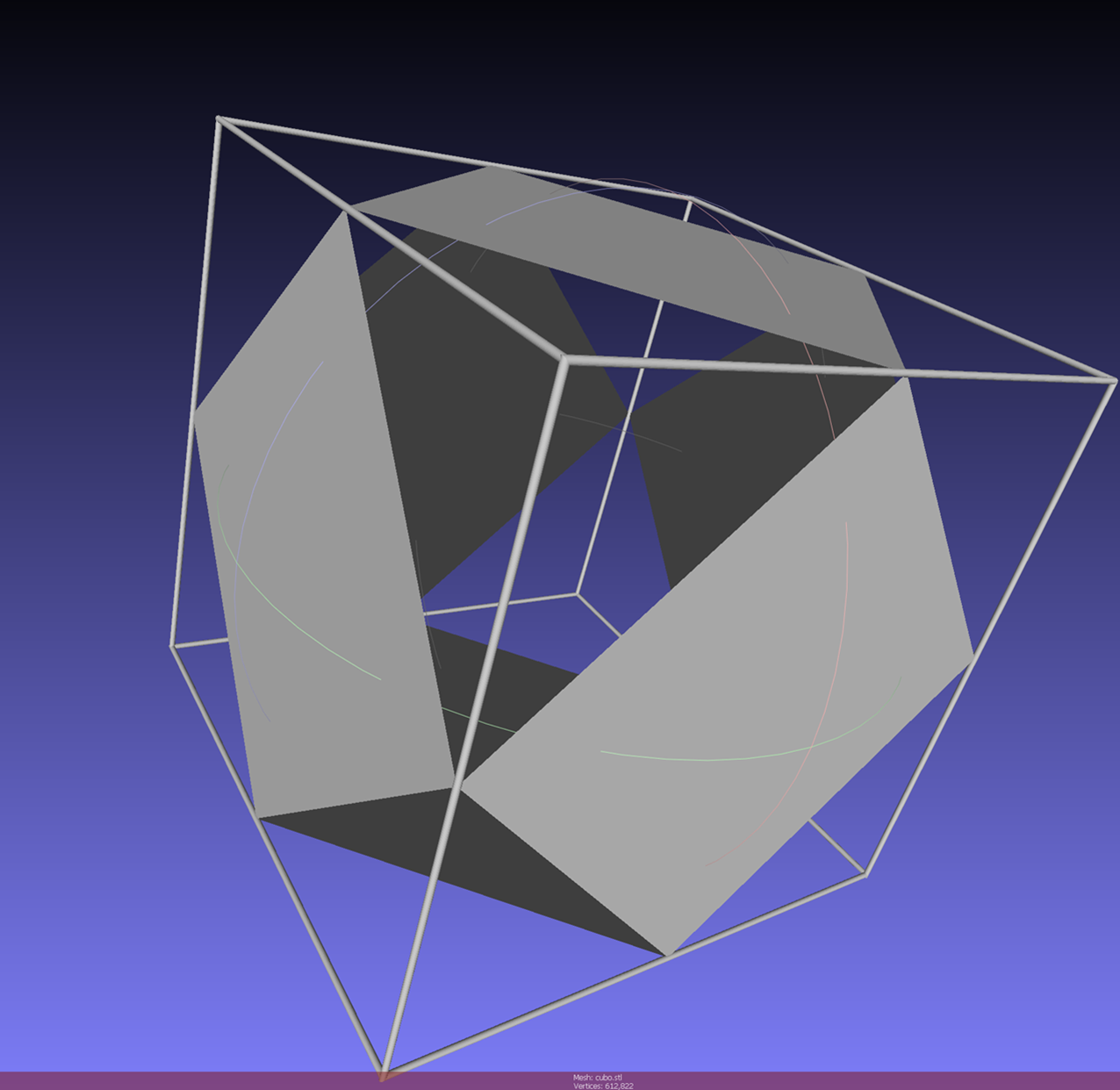
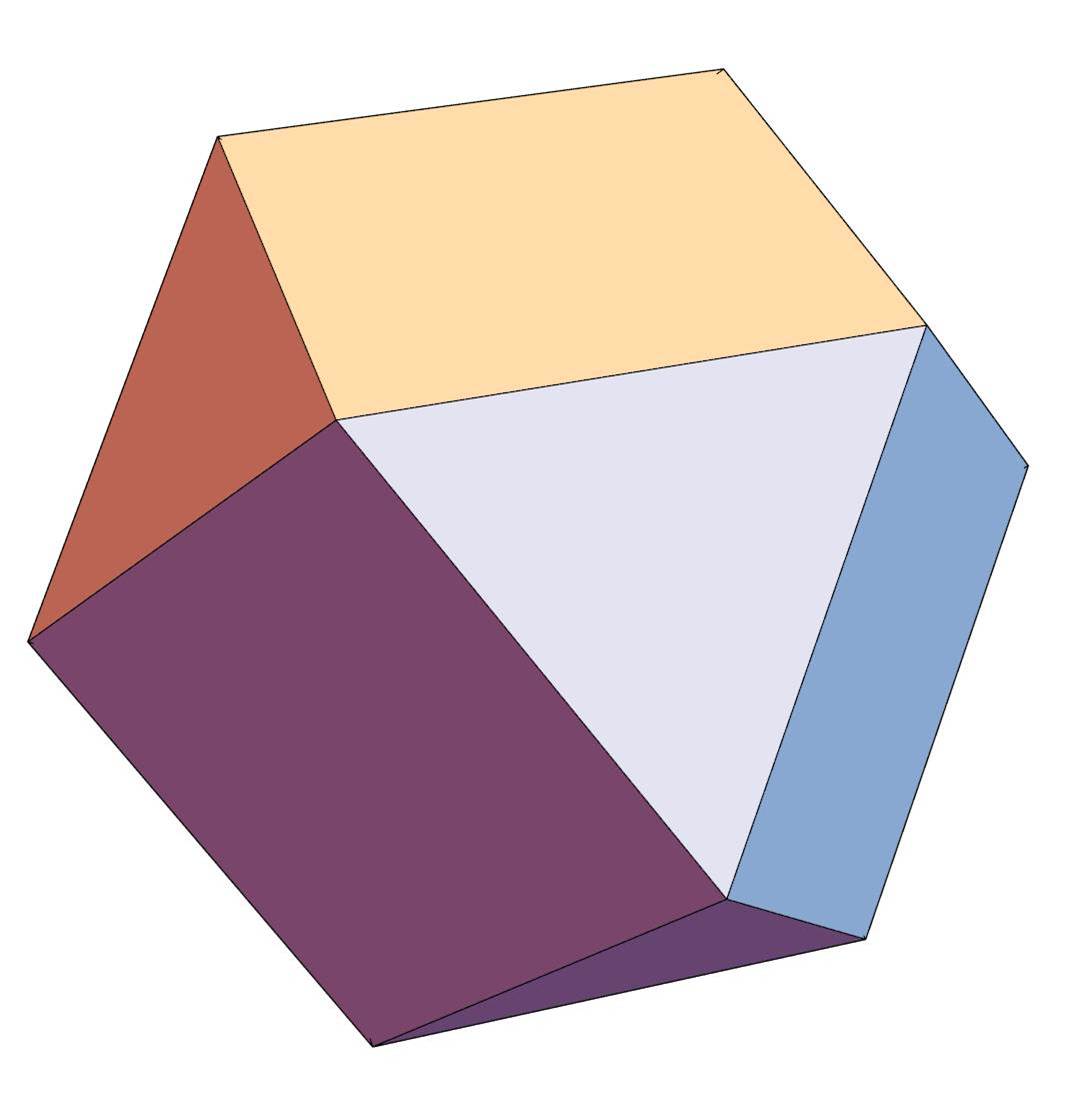
Partial ambo of the faces of the cube
Partial ambo of the faces of an octahedron
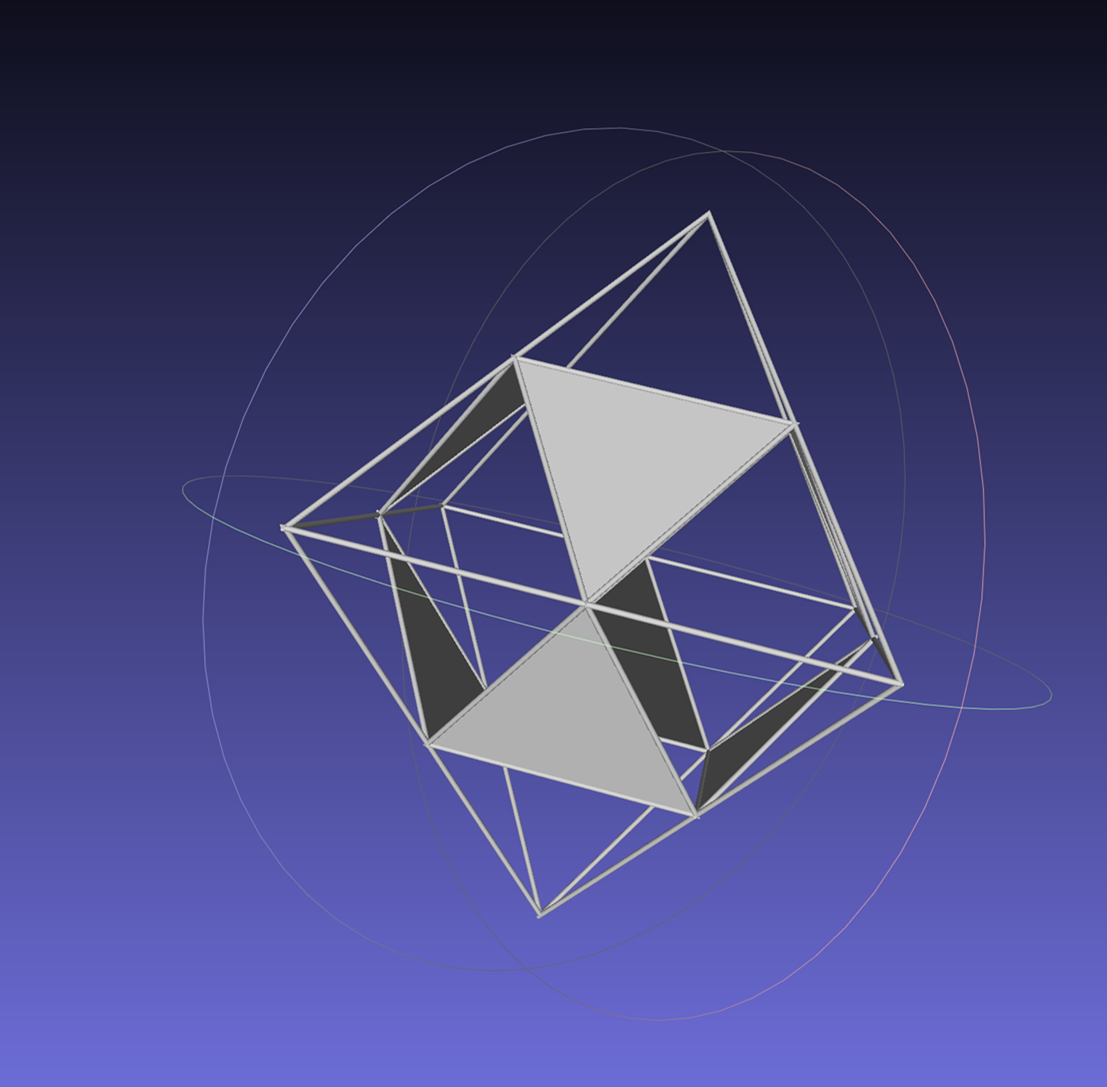
Together they form the faces of a cuboctahedron (cube and octahedron are
duals)
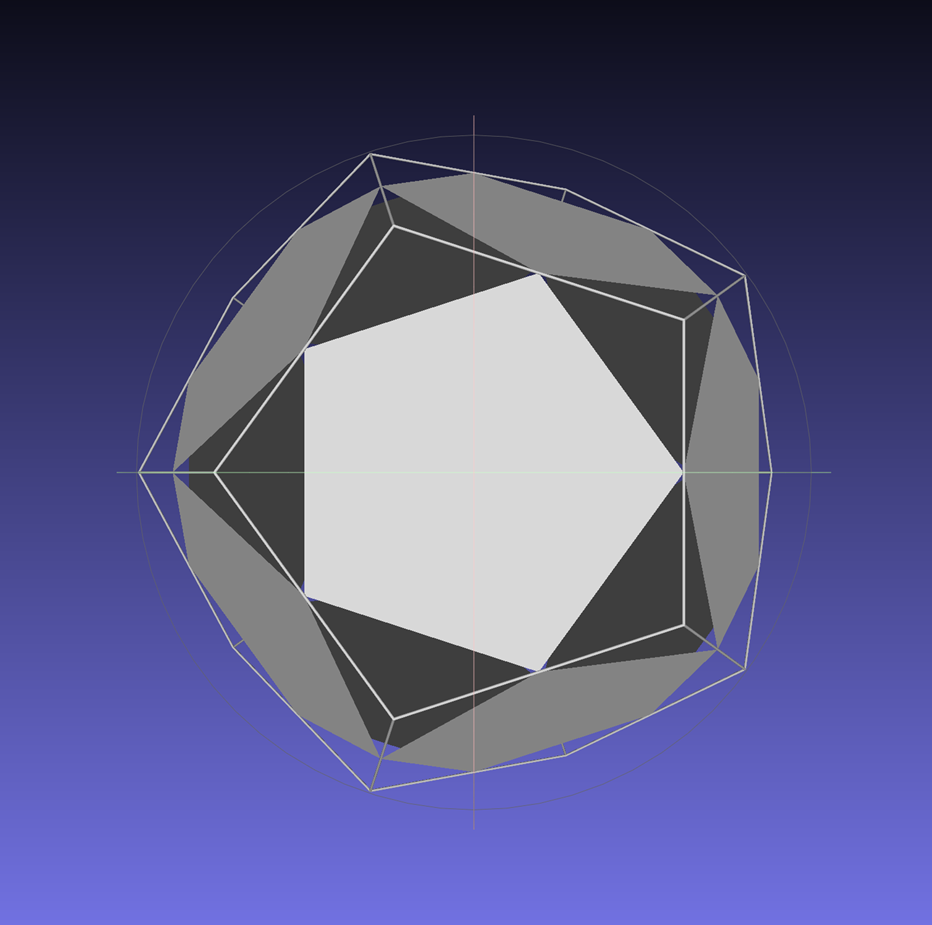
Ambo of the faces of a dodecahedron
Ambo of the faces of an icosahedron
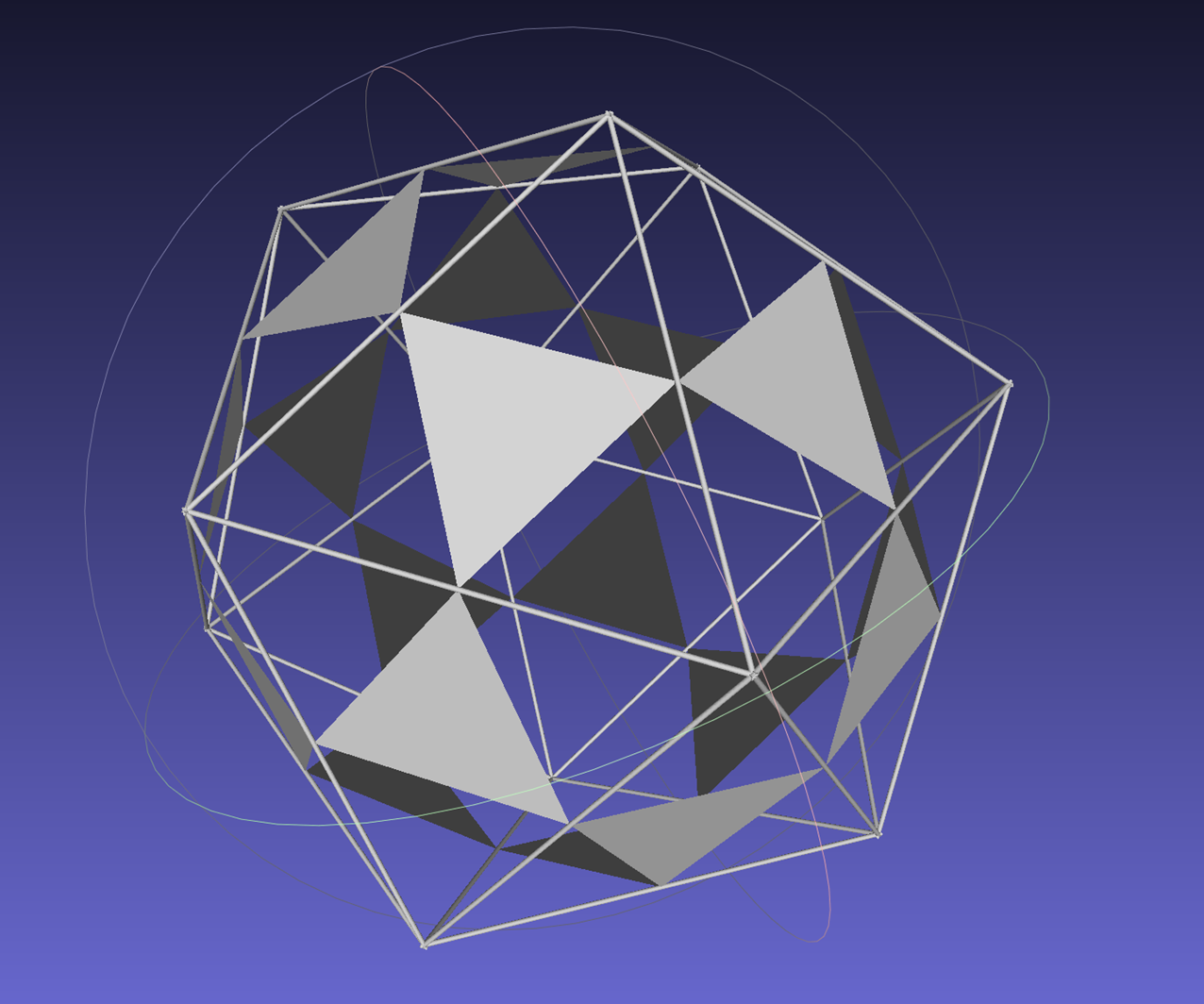
If we put them together we get the icosidodecahedron (the icosahedron is the dual of the
dodecahedron)